

Your Trusted Source for AI, Cloud, Cybersecurity & Tech Education in the USA
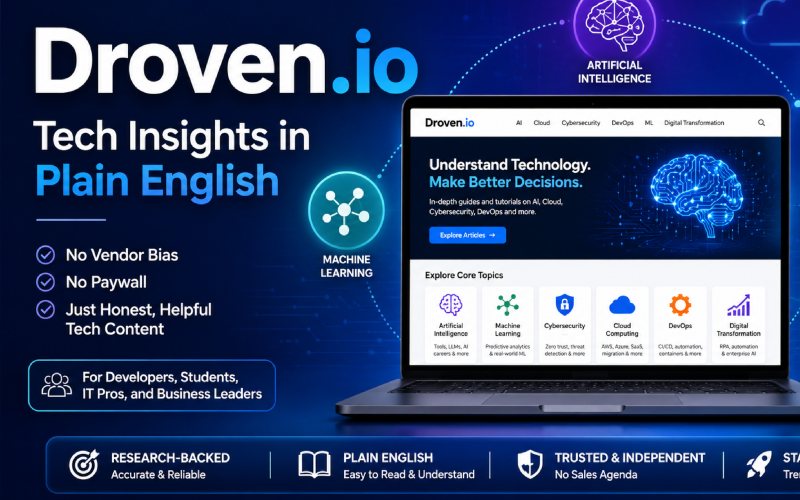
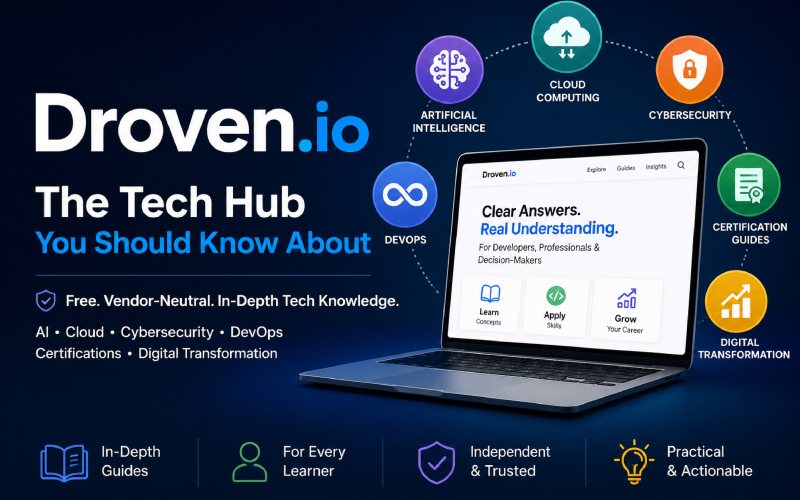
Technology moves faster than most professionals can track. Droven delivers structured, verified knowledge on AI automation, cloud infrastructure, DevOps, and IT careers — written for developers, students, and business leaders who need clarity, not hype.
A Technology Knowledge Platform Built for the USA Market
Droven publishes in-depth, research-backed articles across artificial intelligence, cloud computing, cybersecurity, software development, DevOps, and IT career guidance.
The platform serves developers, students, IT professionals, and business decision-makers who need accurate, current information without the jargon overload that dominates most tech media.
Unlike software vendors or SaaS providers, Droven does not sell tools or services. Its value lies in education: explaining what technologies actually do, where they fit, what risks exist, and how professionals can make smarter decisions before adopting them.
You can read the full mission and editorial standards on the Droven About Us page, which outlines the platform’s commitment to accuracy and practical value.
Every claim traces back to a primary source — BLS, Stanford, IBM, Gartner, Synergy Research, or official vendor documentation.
Droven does not accept sponsored content that passes as editorial coverage. Comparisons use independent benchmarks and verified market data.
Droven covers what you can implement, evaluate, or learn this quarter — not what AI might do in fifteen years.
What AI Automation Tools Are and How They Work
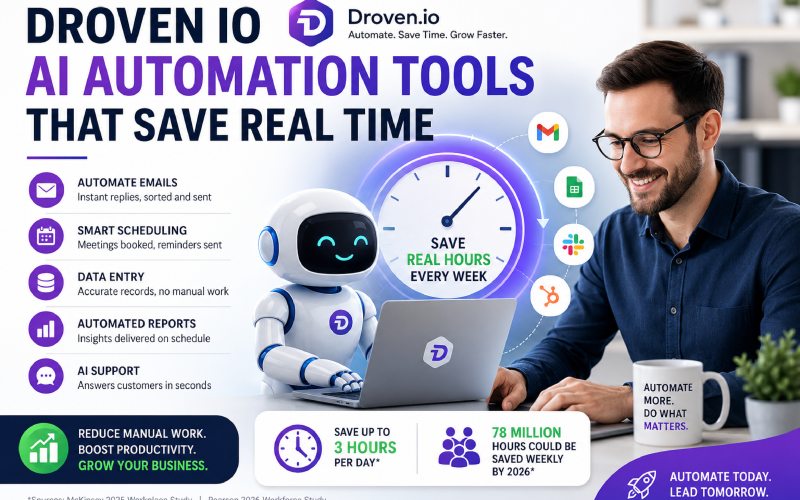
AI automation tools use machine learning algorithms to execute tasks that previously required human judgment — data classification, workflow routing, document processing, anomaly detection, and predictive analytics.
The practical problem most organizations face is not access to AI tools. It is knowing which tool solves which problem. Droven’s coverage of AI automation maps use cases to tool categories, so readers understand the logic before they evaluate vendors.
Core Categories of AI Automation
Software bots that replicate rule-based human actions — data entry, invoice processing, report generation — at scale and without errors.
Systems that ingest data, train models, and deploy predictions into production workflows automatically.
Tools that read, classify, and generate text — powering chatbots, document summarization, and sentiment analysis.
AI that interprets images and video for quality control, identity verification, and medical imaging.
Models that forecast demand, churn, equipment failure, and market behavior using historical data patterns.
Financial services for fraud detection, healthcare for diagnostic support, logistics for demand forecasting, and manufacturing for predictive maintenance.
According to McKinsey’s 2025 State of AI Report, organizations that have deployed AI automation at scale report productivity gains averaging 20 to 40 percent in targeted workflows.
What Is Shaping AI in 2026
The AI landscape in 2026 moves on three primary tracks: model capability expansion, enterprise deployment maturity, and regulatory response.
Large language models moved from demonstration to deployment across 2024 and 2025. By 2026, the conversation shifted from “Can AI do this?” to “How do we govern AI doing this reliably?”
Droven covers how AI drives digital transformation at the operational level — explaining how AI integrates with existing ERP systems, how it changes data architecture requirements, and what new roles organizations need.
Three developments define the near-term trajectory: multimodal models, edge AI running on local devices, and the intersection of AI and quantum computing representing the long-term ceiling for computational capability.
Understanding the Threat Landscape
Cybersecurity spans threat detection, identity management, network security, application security, cloud security, compliance, and incident response.
Key Cybersecurity Topics Droven Covers
Droven covers cybersecurity to ensure developers, product managers, and executives understand the stakes clearly enough to invest in the right defenses.
Source: IBM Cost of a Data Breach Report 2024
Which Cloud Platform Fits Your Stack?
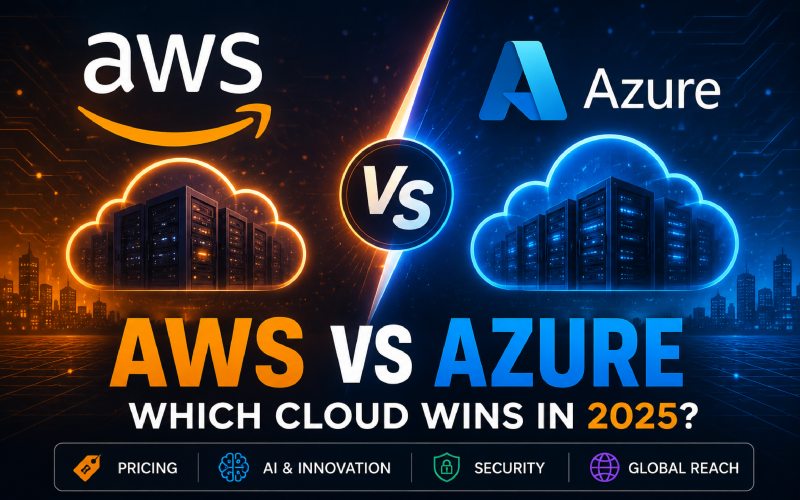
Cloud platform selection is one of the highest-stakes infrastructure decisions a development team makes. Droven covers the AWS vs Azure comparison with data rather than preference.
AWS holds approximately 31 to 33 percent of the global cloud infrastructure market in 2026. Azure sits at 23 to 24 percent but grows faster in absolute revenue terms. The global cloud infrastructure market crossed $395 billion in 2025.
| Comparison Factor | AWS | Microsoft Azure |
|---|---|---|
| Market Share (2026) | ~31–33% | ~23–24% |
| Annual Revenue | ~$130 billion | ~$91 billion |
| Revenue Growth (YoY) | ~17–20% | ~31–39% |
| AI/ML Flagship | Amazon SageMaker | Azure OpenAI Service |
| Best For | Cloud-native startups, broad service depth | Microsoft-centric enterprises, AI workloads |
| Managed Kubernetes | Amazon EKS | Azure AKS |
| Hybrid Cloud | AWS Outposts | Azure Arc / Azure Stack |
| Fortune 500 Adoption | Dominant | 85% of Fortune 500 use Azure |
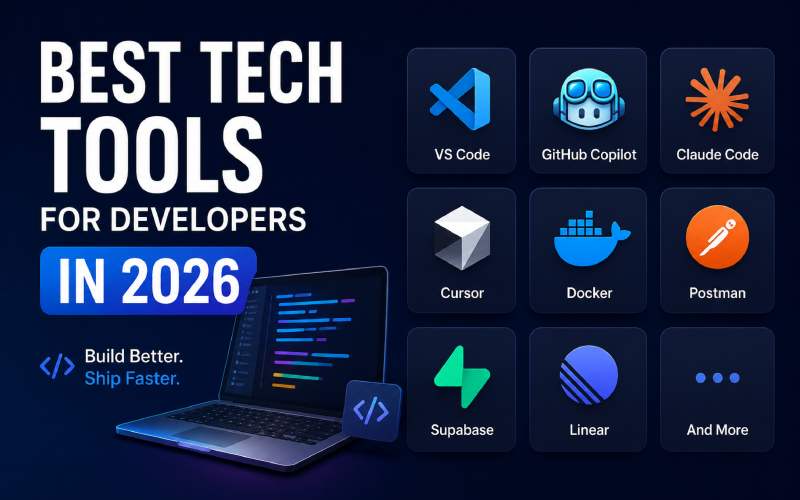
Best Tech Tools for Developers in 2026
Developer productivity depends on tools. Droven evaluates developer tools against practical criteria: learning curve, integration compatibility, performance, and long-term community health.
Git workflows, branching strategies, code review platforms, and team coordination tools.
Continuous integration and deployment tools that automate testing, building, and releasing software.
Docker for packaging applications and Kubernetes for orchestrating containers at scale.
REST and GraphQL API design patterns, testing tools, and documentation standards.
How LLM tools integrate into IDE workflows and where they genuinely accelerate development versus introduce errors.
Tools that track application performance, error rates, and system health in production environments.
Terraform, AWS CDK, and Bicep for managing cloud infrastructure programmatically.
SAST/DAST scanners, secrets managers, and container image scanning tools that integrate into modern pipelines.
From Fundamentals to Advanced Workflows
DevOps connects software development with IT operations to shorten delivery cycles, reduce failure rates, and improve reliability of production systems.
Continuous integration means every code commit triggers an automated build and test sequence. Droven explains how to design pipelines using GitHub Actions, Jenkins, GitLab CI, and CircleCI.
Docker and Kubernetes form the foundation of modern deployment architecture. Droven’s tutorials explain how to containerize applications and configure Kubernetes for high availability.
Droven covers Terraform and cloud-native IaC tools for managing infrastructure through version-controlled configuration files, eliminating configuration drift.
SRE applies software engineering principles to operations. Droven explains SLOs, error budgets, on-call rotations, and post-incident review processes.
Which Certifications Actually Pay Off
IT certifications signal verified competency to employers and often unlock salary bands that experience alone cannot reach.
| Certification | Domain | Typical Salary Premium | Difficulty |
|---|---|---|---|
| AWS Certified Solutions Architect | Cloud Architecture | +$20K–$35K | Intermediate |
| Microsoft Azure Administrator (AZ-104) | Cloud Operations | +$18K–$30K | Intermediate |
| CompTIA Security+ | Cybersecurity Fundamentals | +$10K–$20K | Entry-level |
| Certified Kubernetes Administrator (CKA) | Container Orchestration | +$15K–$28K | Advanced |
| Google Professional Data Engineer | Data & ML Infrastructure | +$20K–$40K | Advanced |
| Certified Ethical Hacker (CEH) | Penetration Testing | +$15K–$25K | Intermediate |
| HashiCorp Terraform Associate | Infrastructure as Code | +$12K–$22K | Intermediate |
| CompTIA Network+ | Networking Fundamentals | +$8K–$15K | Entry-level |
Droven’s certification guides explain not just what to study but how each credential maps to real job requirements.
Roles, Salaries, and Entry Paths
The AI job market in the USA grew faster in 2025 and 2026 than at any prior point. Demand for practitioners who can build, deploy, and maintain AI systems now exceeds supply in every major metro area.
| Role | Median Base Salary (USA, 2026) | Primary Skills | Growth Outlook |
|---|---|---|---|
| Machine Learning Engineer | $165K–$208K | Python, TensorFlow/PyTorch, MLOps | Very High |
| AI Research Scientist | $140K–$200K+ | PhD preferred, Math, Transformers | High |
| Data Scientist | $112K–$165K | Python, SQL, Statistics, Visualization | High |
| AI Product Manager | $130K–$175K | Product strategy, AI literacy, roadmap | Very High |
| MLOps Engineer | $140K–$185K | Docker, Kubernetes, CI/CD, monitoring | Very High |
| NLP Engineer | $145K–$190K | Transformers, BERT, fine-tuning, RAG | High |
| AI Security Analyst | $120K–$160K | Threat modeling, model auditing | Emerging |
| Computer Vision Engineer | $140K–$185K | OpenCV, PyTorch, image pipelines | High |
Entry paths vary by role. Droven’s AI careers content maps the realistic skill-building path for each role, including free and paid learning resources and how to structure a portfolio that gets past automated resume screening.
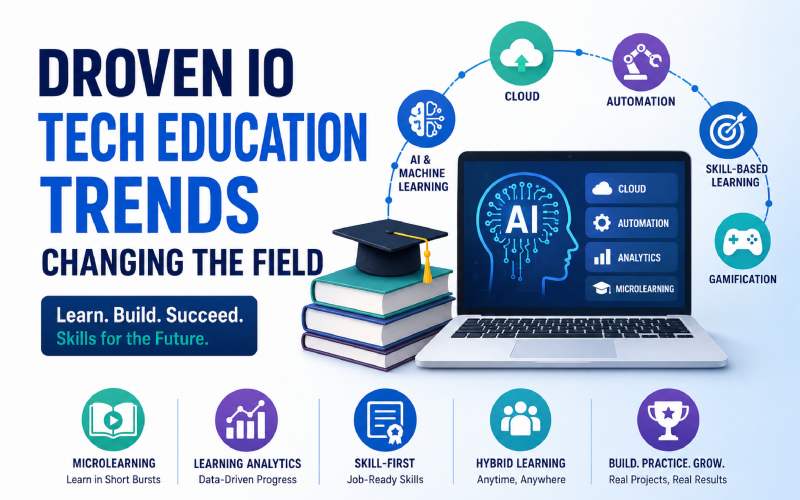
How Learning Technology Skills Has Changed
The market shifted toward self-paced online learning, project-based credentials, and AI-assisted instruction — and that shift is now permanent.
Major US employers including Google, Apple, and IBM removed four-year degree requirements from large portions of technical job postings. Demonstrated skills now carry more weight than the credential itself.
AI tutoring systems that adapt difficulty in real time, generate practice problems, and provide on-demand feedback have compressed the time required to reach proficiency in technical subjects.
Industry micro-credentials from AWS, Google, Microsoft, and Coursera provide a structured alternative to degree programs. Learners stack credentials incrementally from foundational concepts through specializations.
Developer communities on GitHub, Discord, and open-source project forums have become primary learning environments. Contributing to open-source builds skills, creates public proof of work, and establishes professional networks simultaneously.
Writing Code That Survives Production
Writing code that works in development is a different skill from writing code that survives production traffic, team handoffs, maintenance cycles, and security audits.
Unit tests, integration tests, and end-to-end tests pay dividends at the moment a change breaks something three months after you wrote the original code.
Architecture decision records (ADRs) explain why code was built that way — which is the information that matters during refactoring.
Authentication, authorization, input validation, and secrets management built into the initial design cost a fraction of what they cost when retrofitted.
Premature optimization wastes time. Measure where the actual bottleneck is before writing a single line of performance optimization code.
Database migrations, infrastructure configuration, and API contracts should all live in version control alongside application code.
Production code must survive handoffs, maintenance cycles, and security audits — not just pass the first demo. Build for the team that inherits it, not just for today.
Where American Industry Is Heading
The United States leads global AI investment. According to Stanford’s 2025 AI Index Report, the US attracted more private AI investment than the next ten countries combined in 2024.
| Technology | Primary US Industry Impact | Current Maturity | Key Challenge |
|---|---|---|---|
| Generative AI | Software, media, legal, finance | Production-deployed | Governance & accuracy |
| Edge Computing | Manufacturing, healthcare, defense | Early production | Standardization |
| Quantum Computing | Pharma, logistics, cryptography | Research/early commercial | Error correction |
| Digital Twins | Infrastructure, aerospace, urban planning | Production in enterprise | Data integration |
| Autonomous Systems | Logistics, agriculture, transportation | Sector-specific deployment | Regulatory approval |
| Advanced Robotics | Warehousing, manufacturing, healthcare | Scaling rapidly | Human-robot workflow design |
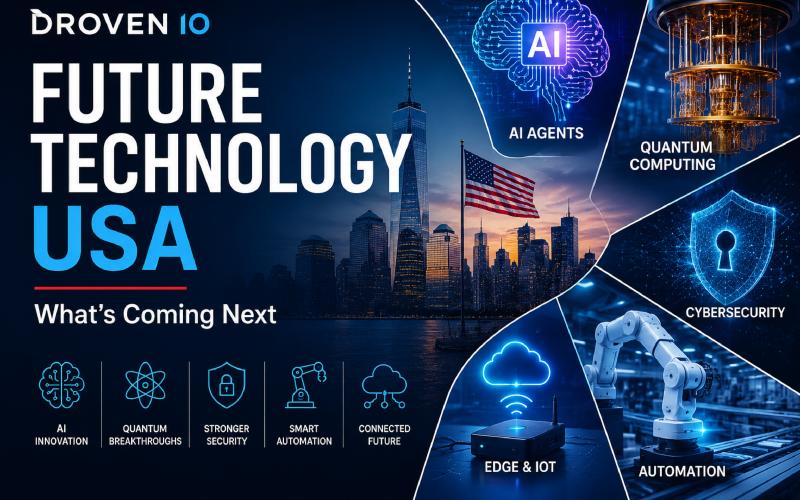
Droven’s coverage of future technology in the USA maps these interdependencies so readers understand not just individual technologies but how they reinforce and depend on each other.
How to Use Droven Effectively
Not every reader uses Droven the same way. Knowing where to start saves time.
Start with the tech education trends section, then move to the IT certification guide to identify which credential creates the fastest path to your target role.
Droven’s comparative content — AWS vs Azure, tool evaluations, and AI platform assessments — is built for practitioners who need data to make decisions, not introductions to concepts.
The future technology and AI in digital transformation sections translate technology trends into operational and strategic implications with cost, change, and risk analysis.
Different from General Tech Media
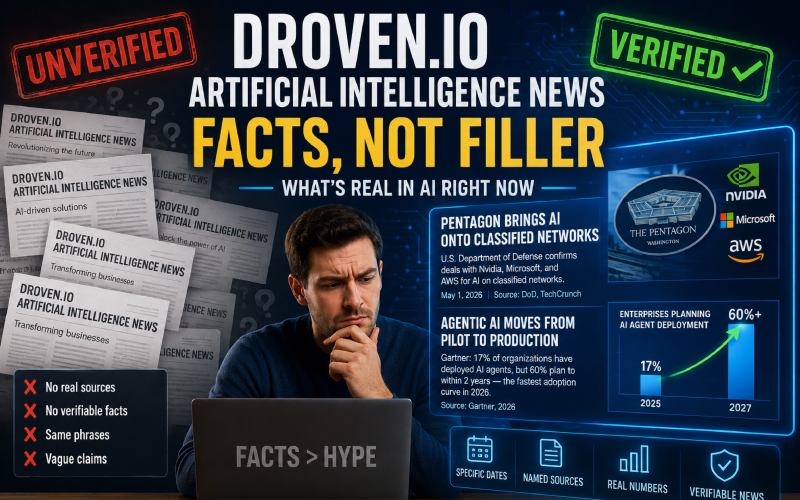
Most technology coverage optimizes for attention rather than understanding. Droven operates differently on three specific dimensions.
Every data point traces back to a primary source — Bureau of Labor Statistics, Synergy Research, IBM and Stanford annual reports, Gartner forecasts, and official vendor documentation.
Droven covers what you can implement, evaluate, or learn this quarter. The gap between research-stage capability and production-ready technology is large, and Droven marks it clearly.
Droven does not accept sponsored content that passes as editorial coverage. Comparisons use publicly available pricing, independent performance benchmarks, and verified market share data.
Who Builds This Platform and Why
Droven publishes content that meets a specific standard: every claim is verifiable, every guide is practical, and every article serves a reader with a real question — not an algorithm looking for keyword density.
The editorial team covers AI and machine learning, cloud infrastructure and DevOps, cybersecurity and compliance, software engineering, IT career development, and tech education.
You can learn more about the editorial mission on the Droven About Us page.
Editorial Coverage Areas
Reach the Editorial Team
Droven welcomes contact from developers, students, educators, IT professionals, and business leaders.